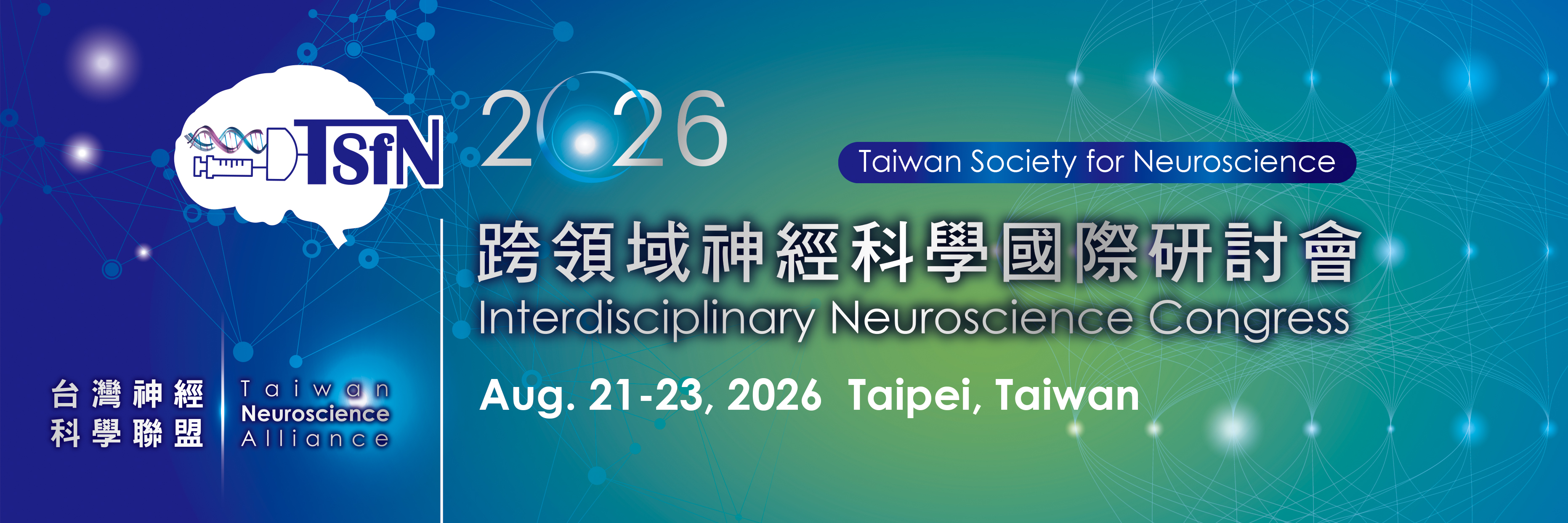
The 4th Taiwan Society for Neuroscience Meeting
The Taiwan Neuroscience Alliance (TNA) is pleased to invite you to join the 4th Taiwan Society for Neuroscience (TSfN) Meeting.
Bringing together 20 neuroscience-related societies, this conference aims to promote interdisciplinary dialogue and innovative collaboration, spanning basic, clinical, computational, cognitive and translational neuroscience, as well as technological and therapeutic advances. Building on the success of the previous TSfN conferences, the 2026 edition will feature keynote and plenary lectures by internationally renowned scientists. The program is designed to integrate talks by scientists from different Taiwanese societies, who have different expertise in the fields of basic, clinical and translational neuroscience. Moreover, the oral blitz and poster presentation provide a platform for research introduction, vibrant discussions and exchange of ideas. We hope to spark interdisciplinary collaborations with new approaches and perspectives to navigate and understand neuronal galaxies in health and disease. We look forward to welcoming scientists of all career stages in different research fields, to join the 2026 TSfN.
Taiwan Neuroscience Alliance
Yi-Shuian Huang (Academia Sinica), President
Chaur-Jong Hu (Taipei Medical University), Vice President
Jin-Wu Tsai (National Yang Ming Chiao Tung University), Secretary General
Shih-Wei Wu (National Yang Ming Chiao Tung University), Program Coordinator
最新消息 News
2026-08-23
Dr. Ann-Shyn Chiang (江安世院士) 的開幕致詞 (opening remark),與大家共勉之。
And this whole-nervous-system connectome teaches us something fundamental.
Behavior does not simply descend from a single command center in the brain. Instead, neural control is distributed and parallel, involving local sensorimotor loops together with long-range circuits connecting the brain, nerve cord, internal organs, and body.
In other words, intelligence may not reside in any single place.
It emerges through interaction—among neurons, across brain regions, and between the brain, the body, and the environment.
At the same time, neuroscience is undergoing another profound transformation.
We can now record the activity of thousands of neurons across multiple brain regions. We can integrate connectomes with gene expression, molecular identity, physiology, development, and behavior.
And increasingly, artificial intelligence allows us to analyze these enormous datasets, reconstruct biological systems, generate hypotheses, and build predictive models.
We are therefore witnessing a remarkable convergence:
Connectomics gives us structure. Large-scale recording gives us dynamics. Molecular neuroscience gives us cellular identity. Behavior reveals function. And AI gives us the power to integrate them.
But we should remember:
A map is not yet a model.
Data is not yet understanding.
And correlation is not yet mechanism.
The next frontier is therefore to transform maps into models, measurements into mechanisms, and explanations into predictions.
Can we move from a wiring diagram to predicting neural activity?
From neural activity to predicting behavior?
From observing disease to anticipating its progression?
And this whole-nervous-system connectome teaches us something fundamental.
Behavior does not simply descend from a single command center in the brain. Instead, neural control is distributed and parallel, involving local sensorimotor loops together with long-range circuits connecting the brain, nerve cord, internal organs, and body.
In other words, intelligence may not reside in any single place.
It emerges through interaction—among neurons, across brain regions, and between the brain, the body, and the environment.
At the same time, neuroscience is undergoing another profound transformation.
We can now record the activity of thousands of neurons across multiple brain regions. We can integrate connectomes with gene expression, molecular identity, physiology, development, and behavior.
And increasingly, artificial intelligence allows us to analyze these enormous datasets, reconstruct biological systems, generate hypotheses, and build predictive models.
We are therefore witnessing a remarkable convergence:
Connectomics gives us structure. Large-scale recording gives us dynamics. Molecular neuroscience gives us cellular identity. Behavior reveals function. And AI gives us the power to integrate them.
But we should remember:
A map is not yet a model.
Data is not yet understanding.
And correlation is not yet mechanism.
The next frontier is therefore to transform maps into models, measurements into mechanisms, and explanations into predictions.
Can we move from a wiring diagram to predicting neural activity?
From neural activity to predicting behavior?
From observing disease to anticipating its progression?
And this whole-nervous-system connectome teaches us something fundamental.
Behavior does not simply descend from a single command center in the brain. Instead, neural control is distributed and parallel, involving local sensorimotor loops together with long-range circuits connecting the brain, nerve cord, internal organs, and body.
In other words, intelligence may not reside in any single place.
It emerges through interaction—among neurons, across brain regions, and between the brain, the body, and the environment.
At the same time, neuroscience is undergoing another profound transformation.
We can now record the activity of thousands of neurons across multiple brain regions. We can integrate connectomes with gene expression, molecular identity, physiology, development, and behavior.
And increasingly, artificial intelligence allows us to analyze these enormous datasets, reconstruct biological systems, generate hypotheses, and build predictive models.
We are therefore witnessing a remarkable convergence:
Connectomics gives us structure. Large-scale recording gives us dynamics. Molecular neuroscience gives us cellular identity. Behavior reveals function. And AI gives us the power to integrate them.
But we should remember:
A map is not yet a model.
Data is not yet understanding.
And correlation is not yet mechanism.
The next frontier is therefore to transform maps into models, measurements into mechanisms, and explanations into predictions.
Can we move from a wiring diagram to predicting neural activity?
From neural activity to predicting behavior?
From observing disease to anticipating its progression?
Can we build digital models that allow us to understand how a nervous system develops, adapts, learns, remembers, ages—and fails?
And ultimately, can understanding biological brains reveal the deeper principles of intelligence itself?
These questions are too large for any single discipline—and certainly too large for any single laboratory.
That is why a meeting like TSfN matters.
TSfN brings together scientists across basic and clinical neuroscience, cognitive and computational neuroscience, neurotechnology, engineering, and therapeutic development.
Each discipline sees a different part of the problem.
Only by connecting these perspectives can we begin to see the whole.
The future of neuroscience will depend not only on better microscopes, more powerful computers, or larger datasets.
It will depend equally on our ability to connect people, disciplines, technologies, and ideas.
And Taiwan has a unique opportunity in this new era.
Although our neuroscience community is relatively small, Taiwan has internationally recognized strengths in medicine and biomedical research, together with world-leading capabilities in engineering, semiconductor technology, computation, and artificial intelligence.
Our strength lies not in scale, but in integration.
By bringing these strengths together, Taiwan can play a significant role in shaping the next revolution in neuroscience.
I would especially like to say a few words to the students and young investigators here today.
You are entering neuroscience at one of the most exciting moments in its history.
Do not be constrained by traditional boundaries.
Learn biology—but also computation.
Understand experiments—but also AI.
Study molecules and individual neurons—but always ask how they contribute to the whole system.
Most importantly, ask questions that today's technology cannot yet answer.
Those are often the questions that inspire tomorrow's technologies—and create tomorrow's breakthroughs.
Over these three days, I encourage you to cross disciplines, challenge assumptions, share bold ideas, and build new collaborations.
Major discoveries often begin with a conversation between people who see the same problem differently.
My sincere thanks to the Taiwan Neuroscience Alliance, participating societies, organizers, speakers, sponsors, volunteers, and everyone who made this meeting possible.
Let TSfN 2026 move neuroscience:
from reduction to reconstruction, from mapping to prediction, from circuits to intelligence, and from discovery to better human health.
Welcome to TSfN 2026.
I wish you all an inspiring and productive meeting.
Thank you.
2026-08-21
敬聘 Dr. Ann-Shyn Chiang (江安世院士) 成為台灣神經科學聯盟 (TNA)的 終身榮譽顧問 (Lifetime Honorary Advisor).
2026-04-25
The 4th TSfN will be held on August 21-23, 2026 in Taipei Veterans General Hospital. Please keep notice of our website for the updated information.
第四屆TSfN跨領域神經科學國際研討會訂於2026年8月21-23日於台北榮總致德樓舉辦,敬請留意報名資訊。